

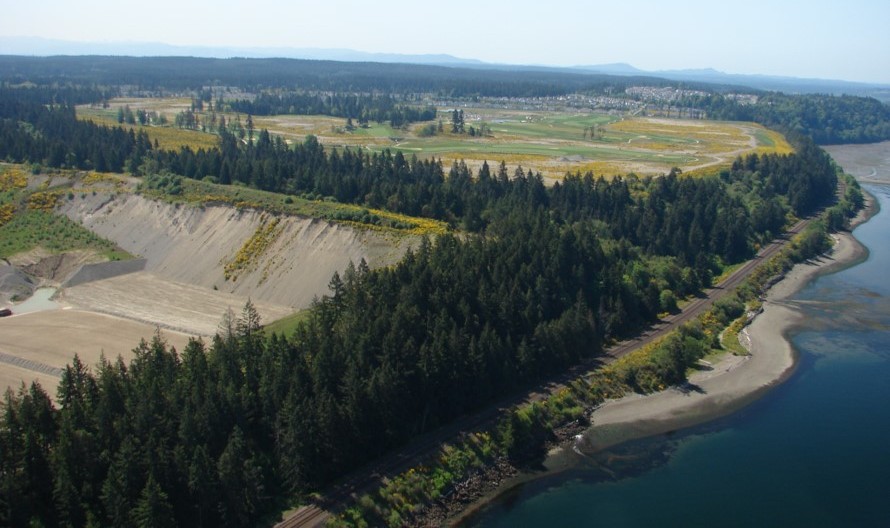
by Kirk Kirkland
On June 11, 2026, the DuPont Hearing Examiner approved the South Parcel gravel mine expansion. The final decision confirms that the project will create significant environmental disruptions. The approved permit fails to provide adequate mitigation for catastrophic stream loss, wetland destruction, wildlife habitat degradation, and heightened forest fire risks due to aquifer depletion.
To understand why this happened, we must examine the three administrative maneuvers built into the final ruling.
1. The Dewatering Trick: A Calculated Net Loss
The Hearing Examiner’s June 2026 decision confirms that dewatering the Vashon Aquifer will permanently destroy the surrounding aquatic ecosystem. The Final Environmental Impact Statement (FEIS) confirms that groundwater drawdowns from years 9 to 14 will rob the Sequalitchew Creek ravine of up to 83% of its flow during peak operations. After mining ceases entirely, the creek will permanently lose an average of 79% of its natural baseflow.
Furthermore, neighboring public wetlands face severe, unmitigated drops in water levels. Wetland 1D will drop by three feet, Pond Lake by two feet, and multiple other wetlands by a foot. The Hearing Examiner openly conceded on Page 9 that CalPortland’s baseline Restoration Plan will likely fail to mitigate these severe drawdowns. To bypass this catastrophic finding, the applicant’s expert testified that multi-foot water losses are “minor” because seasonal dry spells will make the destruction difficult for the public to observe.
The true structural trickery occurs at the 14-year mark. CalPortland’s temporary groundwater pumping mitigation is scheduled to simply switch off when active mining concludes. This artificial cutoff ensures that the massive aquifer depletion becomes permanent. It leaves a dried-out watershed behind.
Published decisions show where the city’s environmental experts stated on the record that this data represents an absolute net loss of ecological function. The Hearing Examiner chose to override his own experts’ data. He ignored the mandatory zoning standard for wetland mitigation, which requires no net loss of function and value to streams and wetlands when the aquifer is dewatered.
2. The Decision Shifts the Burden of Enforcement to the Public
The Hearing Examiner chose to issue a permit approval without reviewing completed environmental mitigation plans. Condition 2 and Condition 21 establish that CalPortland cannot begin digging until they submit future, unwritten critical area and hydrological reports. These baseline scientific documents include the actual plans to measure and mitigate the destruction of Sequalitchew Creek and Edmonds Marsh. The Examiner certified that all local development regulations were “satisfied” under Conclusion of Law No. 4, while simultaneously declaring the permit legally ineffective under Condition 38 until these missing studies are submitted to the city’s Planning Department.
This administrative shortcut directly insulates CalPortland from public scrutiny during the open hearing process. Instead of forcing the developer to defend its remediation science in a public courtroom, the city shifted the entire compliance review behind closed doors. Condition 21(c) mandates that future, highly technical wetland mitigation plans will be rubber-stamped by city planning staff via a “Type I administrative interpretation.”
This tactical shift strips away the public’s standard notice and comment periods. To enforce these permit conditions, local citizens must constantly police the city planning desk to find out when the approvals are signed. Once CalPortland receives an interpretation, the public faces a tight 14-day administrative window to fund an independent appeal back to the Hearing Examiner. The city intentionally designed an enforcement mechanism that relies entirely on volunteer public resources, ensuring the conditions are highly unlikely to ever be monitored or enforced.
3. Missing Fences and Signs Over Cleanup Areas
The Hearing Examiner extended this pattern of deferred planning to known public health hazards on the property. The Department of Ecology documented extensive heavy metal contamination across the South Parcel linked to the historic Asarco Tacoma Smelter plume. Condition 24 mandates that CalPortland must conduct soil characterization for arsenic and lead within the Sequalitchew Creek Open Area and the Mine Setback Area. However, the developer is not required to submit these toxic mapping results or a remediation strategy until long after the active permit is granted.
The text of Condition 24(b) provides CalPortland with a seamless legal escape hatch to avoid physical cleanup costs. If soil sampling reveals elevated arsenic or lead levels exceeding the background threshold of 32 mg/kg, the developer is explicitly authorized to bypass active soil extraction. Instead, the order allows the use of institutional controls, including restrictive covenants, warning signs, and perimeter fences, in place of physical remediation.
This clause allows the developer to actively disrupt a toxic plume site while leaving the heavy metals in place. The Hearing Examiner accepted a future promise to put up warning signs as a valid substitute for a verified, upfront public health protection plan. By approving this framework, the decision permits CalPortland to advance its mining timeline while pushing the permanent chemical stabilization liabilities entirely past the point of public input.
Want to challenge the hearing examiner’s decision?
If you are angry, recognize the injustice here, and want to know why this decision violates the law, these are the three core issues that provide a sufficient basis to challenge the Hearing Examiners Decision. They prove a direct violation of local ordinances and state land-use mandates:
Issue 1: Critical Area Violation of the “No Net Loss” Myth
The law says a developer cannot destroy a public waterway unless they replace every single drop of its ecological value. To compensate for digging up natural wetlands, developers are routinely required to build a new, artificial wetland nearby that is two to three times larger than the one they destroyed. This safety ratio exists because man-made wetlands frequently fail within a few years when soil levels dry out or weeds choke out native plants.
In this case, the Hearing Examiner approved the project despite admitting that Sequalitchew Creek will permanently lose up to 83% of its water. Nearby wetlands will dry down by one to three vertical feet, killing off the native plants and salmon habitat completely. CalPortland is not required to build a functioning, oversized replacement wetland to absorb this significant blow before they start mining. Instead, they were granted a permit based on a paper promise of “no net loss” while the water feeding the creek is permanently shut off.
Issue 2: Unlawful Post-Permit Deferral
“Baseline environmental data” is simply the scientific measurement of nature before a bulldozer touches it. It tells the community exactly how deep the water table sits, where protected wildlife lives, and how much pollution is already in the soil. Washington law states that a city must collect and verify this environmental report before they vote on a permit, ensuring they understand the true cost of the project.
The Hearing Examiner violated this rule by granting the permit first and asking for the science later. Condition 21 allows CalPortland to skip showing its final water modeling and wetland protection plans until after the approval is signed. This is the equivalent of a bank giving a borrower a blank check before verifying their income or checking their credit. Because the critical hydrology studies will be completed in secret after the approval, the city has no legal way to evaluate the true environmental damage before the digging begins.
Issue 3: Illegal Modification of Due Process (The Locked Door Strategy)
“Procedural due process” is a citizen’s constitutional right to have a say before the government allows a corporation to damage their neighborhood. In the city of DuPont, major environmental decisions are legally classified as “Type III” actions, meaning they require open public notices, town hall meetings, and live testimony. This transparent process allows neighbors, hikers, and birders to look at the developer’s data and point out flaws directly to a judge.
The Hearing Examiner deliberately dismantled this system by downgrading all future wetland reviews into “Type I” administrative actions. Type I actions are closed-door staff check-offs that require zero public notice, zero public comment, and zero neighborhood meetings. If city staff quietly approve a flawed CalPortland water plan, the public is never notified that the decision was signed. Local citizens must constantly police the city planning desk on their own dime, locate the document, and fund a rapid 14-day legal appeal just to get back into the courtroom.
A Reflection On Our Gravel Mine History
Over 30 years ago, I attended a meeting at Helen Engle’s home where the attorney for the Tahoma Audubon Society and the Nisqually Delta Association told us about a historic settlement agreement. That agreement successfully addressed many significant environmental concerns, and the groups were awarded more than a million dollars to protect our local environment.
Since then, the Tahoma Audubon Society has changed its name to the Tahoma Bird Alliance, and no one answered the phone at the Delta Association. Furthermore, I wasn’t able to find an attorney in Tacoma who would represent us in court pro bono.
Attorneys know the grim reality of local land-use battles. Once a gravel mine is approved, a Superior Court judge does not want to stop an expansion that keeps employees busy and gravel miners donating to city and state taxes. The system is designed to favor corporate timelines over long-term environmental protection, leaving local volunteers to hold the line alone.
On June 25, 2026, the night before the Superior Court Appeal was due and one day before the due date, I met with a few people on a Zoom call and explored how we could work together to make an appeal and find an attorney at the last minute.
We discussed the injustice here, then reviewed how this decision violated the law and why it couldn’t be stopped. It seemed like a long shot, but each person cared so much about the forests, stream and trails enough to outline a way the mine could be stopped.
Want to join us? Contact me at kirkkirkland5@gmail.com