

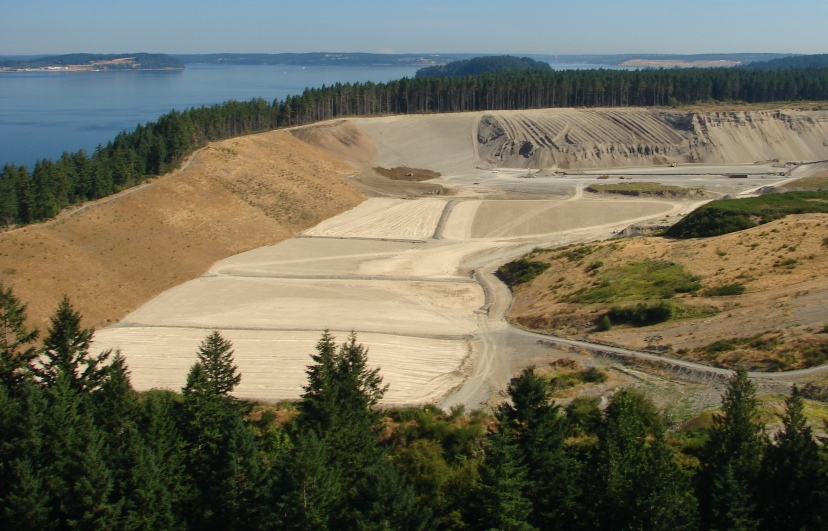
The public hearing to review the Final Impact Statement on the expansion of the Dupont gravel mine turned into a circus The seventy-two members of the public in attendance had to wait four hours before given an opportunity to speak.
By 2 PM, only a dozen or so people had returned after the lunch break. Don Russell was not one of them. He explained that “my endurance at 95 years of age didn’t allow me to stay any longer. I had it after an hour and forty five minutes of mind-numbing FEIS recitation by the City of DuPont’s staff.”
Don Russell is the author of numerous studies of the mine. He has written comment letters on the project for over the last thirty years.
By lunch time, the manner in which this hearing had been conducted had created an angry audience. This was a denial of their free speech, as well as a violation of the Appearance of Fairness Doctrine, which is a requirement for Conditional Use Permit Hearings.
At the public hearing for a tiny home village in Spanaway, similar misconduct asked more then one hundred attendees to wait from 9:00 in the morning until after 6:00 in the evening. Like the Dupont hearings, attendees had to wait for hours as the planning staff presented the staff report and other documents.
Also, like at the Dupont hearing, half of the people left at lunch. Nineteen were able to testify after 2 PM. It is unknown as to what happened to the people attending on Zoom. In Dupont, 53 of the 72 attendees were denied their right to participate in this permit hearing.
Two environmental organizations asked the Dupont Hearing Examiner to hold a second hearing, so that the fifty-three people in person who had been denied their three minutes of comments would be able to speak.
The Clover Creek Restoration Alliance and the Environmental Coalition of Pierce County asked the Hearing Examiner to hold an evening meeting that would enable people who were working during the day to attend.
This proposed Final Environmental Impact Statement is seriously flawed. Public comment at the end of the proceedings would enable attendees to give the Hearing Examiner specific information about the flaws in the FEIS before he writes his decision.
The FEIS has identified several Significant Unavoidable Adverse Impacts that the staff has said will not be able to be mitigated. One of the most serious is that mitigation proposed to return flow to Sequalitchew Creek. The mitigation proposal is only “temporary” mitigation because the creek’s flow will stop when pumping ceases at the mine.
At the very end of the Friday hearing, an interesting thing happened — the staff announced that the city had changed its mind and made a substantial change to the EIS.
For weeks, the city deemed the proposal would have significant harmful impacts on the off-site wetlands like Edmond Marsh as a result of the dewatering of the Vashon Aquifer. Such a last minute changes without any feedback regarding the change, violates State law, which requires the preparation of a Supplemental EIS if there is “substantial changes” to a proposal that is are likely to have “significant adverse environmental impacts”
The preparation of a new Supplemental FEIS requires public review procedures as for the previous FEIS, which includes “public notice and an opportunity for comment as outlined in other sections of WAC 197-11”.
Alternative 1 in the FEIS allows the current gravel operations to dewater the aquifer and cut down numerous trees, including very large Garry oaks many hundreds of years old. It also alloys the destruction of a Edmond Marsh or Sequalitchew Creek’s because after pumps are turned off fourteen years from now there will be no source of water.
In Chapter 4, on pages 4-27, the FEIS Cumulative Impact Analysis does not acknowledge the long term significant impacts of dewatering Edmond Marsh. In addition, Alternative 1 it does not implement the legal agreements of 1994, 2011 and 2021 that call for permanent wetland function of Edmond Marsh.
The 1994 agreement states that the mine operation would not seek any “permits in the future to mine in a manner that would significantly impact the flow of Sequalitchew Creek.”
The Nisqually Indian Tribe is .concerned about the historic village that once occupied parts of the proposed mining area. The Tribe has filed an environmental appeal concerning the Cultural Resources portion of the FEIS, challenging whether the review in the FEIS was actually complete. The will have a separate hearing prior to the Conditional Use Permit which will decide if the FEIS is adequate.
Sequalitchew Creek used to be an important salmon run for the native people living in the area of present-day Dupont. They lived nearby and some worked with and treaded with the Hudson Bay Company at Fort Nisqually.
The Fort had two sites near Sequalitchew Creek: one is a fenced area inside the Home Course, a golf course built by the Quadrant Corporation near Fort Lake, and the second site is now a fenced area on Center Drive across from the current Dupont City Hall.
According to information provided by the Nisqually Tribe’s attorney and in testimony, native people were living around the area in 1832, when the Hudson Bay Company decided on the location for Fort Nisqually. Their camps moved in the summer and winter as berries ripened, camas bloomed, elk and deer arrived in the meadows, and the salmon ran up the creeks and rivers.
After 2 p.m. session of the hearing, when testimony resumed, the Zoom connection failed as Sean Arent, president of the Clover Creek Restoration Alliance, was speaking. There was a great deal of confusion as the City attempted to restore the connection, which left people wondering what was happening.
At this point, about nineteen, wishing to speak, remained in the chambers. When the Zoom connection was restored, Arent asked if he could start his testimony from the beginning. His request was denied.
Sean Arent’s remarks have been posted online. He asks some important questions about this project, read them here at https://forevergreencouncil.org/blog/
It is very difficult to stop a mining operation from continuing its operations with an appeal of the Final Environmental Impact Statement. The permit to mine is vested with conditions allowing it to continue until all the gravel is gone.
If someone wants to stop mining in the aquifer, one chooses Alternative 2. It describes how the mine will continue to operate without disturbing the aquifer.
The controversial mining in the aquifer as proposed in Alternative 1, which threatens Edmond Marsh, is a class 1 wetland. It also removes trees on 170 acres of forests, including landmark trees.
These losses are not allowed in Growth management policies or city ordinances that mandate no net loss of wetland and stream functions. Dewater of the aquifer degrades additional wetlands in the mining area and reduces the recharge capacity that protects water quality.
The long term use of the abandoned gravel pit will be as a residential area or a warehouse district. If the aquifer is drained, however there will be no local water supply as the mine will have salinted the Vashon aquifer.
Fortunately the city of Dupont has strong Critical Area Ordinances and Comp Plan Policies to protect wetlands and Sequalitchew Creek wetlands and trees. The FEIS document has 2,429 pages. It is mind numbing to read it. But somewhere in those two thousands of pages there is the answer to how the dewatering will effect the wetlands and trees.