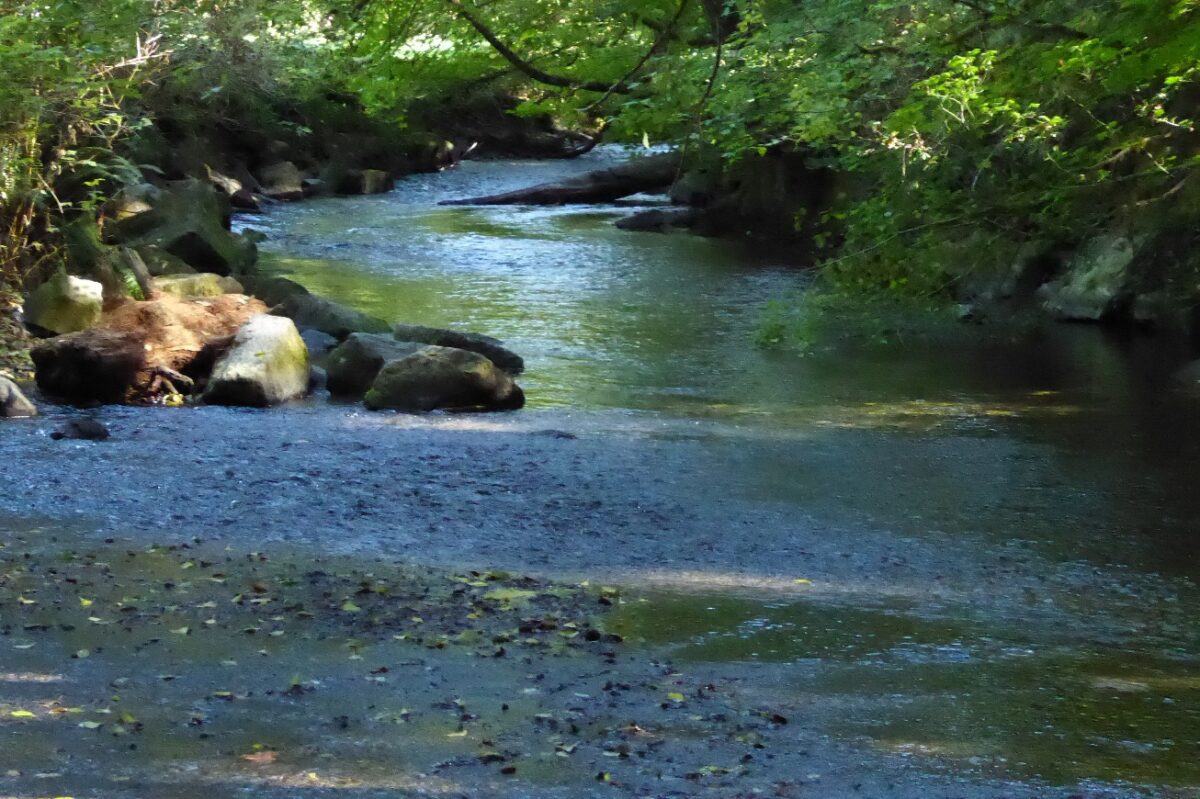
After the first 500 salmon were released above the Chambers dam it has been a long wait to see them upstream. Summer drought has affected the creek. Will the fish make it, were our previous restoration efforts enough?
Online comments discuss the past efforts describe the next phase of creek restoration.
In August we learned that the WDFW fish ladder was going to open to Chinook salmon and allow them to pass through the dam. This significant breakthrough in policy set off a discussion about what can be done in the next phase of the restoration of Chambers Creek Watershed.
The Watershed Council is planning a Watershed Festival on October 11, 2025. if there was a time and place to review what has been done in the past and what can be done in the future it is at the Watershed Festival planned in October:
Clover Chambers Watershed Festival
11 a.m. to 4 p.m. October 11, 2025
at Clover Park Technical College’s
Natural Resources Laboratory and Research Park
After the WDFW fish ladder was opened in August, I asked for comments on what the next phase of restoration might look like. Four people, Bob Warfield, Al Schmauder, Don Russell and Kurt Reidinger, rose to the challenge by sending over a thousand words about how the creek habitat has changed in the last 100 years which also included a few insights into the direction that we should go in the next decade.
Here is a summary of their conversation. It shows how far we’ve come and examines what needs to be done after creeks are full of Canary Grass and the ground water levels have declined, ending year-round flow in many creeks:
Don Russell said:
Now if we can only get our governmental agencies to work with us citizens to make the watershed above the dam a receptive and fit habitat for salmon.
Kirk Kirkland responded:
Getting the County Council and Surface Water Management to work with us is easier now after the November 2024 election. The election added Ryan Mello to the County Executive’s seat and voted in one more Democratic County Council member, who could ensure passing of the county executive’s agenda and change priorities in the budget of Surface Water Management.
Curt Reidinger provided detailed information about previous hatchery runs and in particular what he experienced at his property on Morey Creek.
This stream from Spanaway Lake flows along Spanaway Loop Road before it connects with Clover Creek where they join before flowing into a pipe underneath McChord Airfield.
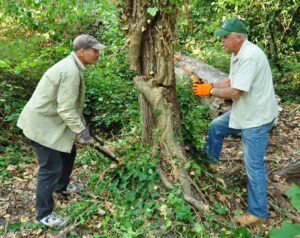
Curt and Al Schmauder remove Ivy from large tree providing shadow and cooling as part of the restoration program that planted many of these trees in Clover Creek Reserve in Spanaway.
From Curt’s email:
“Whether the surplus hatchery Chinook can successfully spawn and produce some offspring is a really minor issue given the overall state of the watershed’s streams. Relatively small numbers of Chinook probably always existed in Chambers Creek and other streams like it. A mid-20th century annual report from the old Fisheries Department (attached) even mentioned the Chambers Chinook run.”
Not much is known about pink salmon as they were likely destroyed early on. Sockeye likely existed as far up as Spanaway Lake (their small size, i.e., “little redfish”, may reflect a restricted migration pattern confined to Puget Sound-Georgia Strait). Chambers steelhead were a key component of the government’s hatchery program for years. Coastal cutthroat also likely existed in numbers.
Other stream resident fishes also existed in the watershed. All the diadromous animals used the estuarial habitat of Chambers Bay to a greater or lesser extent. But chum and pink which head to saltwater shortly after they emerge from the gravel may have benefited the most from that transition zone. Which is why getting rid of the Chambers Bay Dam should be a priority.”
Since the increase in population with the designation of an Urban Growth Area in the Clover Creek Watershed, “The later shift to groundwater exploitation with little or no restraint was devastating. Certain stretches of Clover Creek no longer flow any more, not even in winter. As a young kid, I remember seeing it bankful at the Spanaway Loop Road crossing during winter.
The rise of the petroleum-asphalt culture sealed the watershed’s fate. It facilitated urban/suburban sprawl into the farthest reaches. The concomitant pollution from automobile traffic is particularly deadly to aquatic environments. It seems like every few weeks I get a report on new research about the effects of the tire chemical 6PPD-Q. And that’s just one chemical.
Note: This year the Pierce County biologist developed a filtering system that removed 6ppd-Q from storm drains. It will be implemented in the next year as part of a program to filter storm drains from oil and gas. It will be implemented first in the upper reaches of Clover Creek in Spanaway and Parkland.
A couple of personal observations from Curt Reidinger:
I have a small plot of land with a small creek flowing through it. I’m trying to plant trees (alder & willow) in the riparian zone to combat invasive reed canary grass and yellow flag iris, both of which have a tendency to choke off the channel. It’s hard, sweaty work.
There are not many fish in the creek at all. As I do this, I reflect that this little creek probably served as a conduit for millions of fish traveling up and down its channel for thousands of years. Resident stream fishes were actually fairly abundant when I first saw the creek in the late 1950’s. Now it’s largely dead.”
In late summer Curt Reidinger attended a presentation to explain their Good Neighbor Village project. The TRM promoters “gave a thumbnail sketch of TRM history and showed pictures of the original project in Texas, all with glowing words about the salvation the project promised.”
“As I sat there about 150 yards from the original Clover Creek channel, now waterless, with any flow diverted into an asphalt-lined stormwater channel, I realized that none of the people present had any inkling that a very important biological habitat once existed on that property.”
____________________________________________________
From Al Schmauder:
Kurt,
You provided an excellent explanation of the human impact on our watershed.
Thanks for sharing your knowledge and observations.
Al
____________________________________________________
From Don Russell
Kurt,
Your thoughtful and insightful response to my original email on this subject deserves to be read by all members of the Chambers-Clover Watershed Council, the Environmental Coalition and Clover Creek Restoration Alliance.
There is no comprehensive WRIA 12 watershed restoration plan that guides collaborative citizen-tribal-governmental stewardship actions in the Chambers-Clover-Sequalitchew Creek watershed. What few actions have been effective have been negated by inaction on the part of Ecology, WDFW, and DNR to apply and enforce provisions of the Federal Clean Water Act.
I have been a witness to this governmental agency failure for the active part of my 95 years. So far I have yet to see a really effective stewardship action group evolve in response to our State/County/City governmental agencies neglect of our watersheds diminishing and increasingly polluted freshwater (surface/groundwater) resource.
____________________________________________________
To my friends,
Thurston County has a Stream Team entity which provides a coordinated approach to address watershed issues. Pierce County chose to take another route in the early 1990s. The watershed councils failed to be effective in Pierce County. I was the president for many years, so blame me.
Al Schmauder
____________________________________________________
Well friends, there you have it. The watershed council is planning a Watershed Festival on October 11, 2025. If there was a time and place to “put together a comprehensive WRIA 12 watershed restoration plan, these are the people and this is the place to start:
Clover Chambers Watershed Festival
11 a.m. to 4 p.m. on October 11, 2024
at Clover Park Technical College’s
Natural Resources Laboratory and Research Park