

by Kirk Kirkland & Al Schmauder
Before the 1970 housing boom in the Pierce County’s Urban Growth Area, Spanaway and Clover creeks had salmon in their streams. After 25 years of restoring the creek by adding fish ladders and implementing various restoration plans for Chambers Canyon and Clover Creek, this summer it was time to see if the plans were sufficient for a salmon run to return and spawn.
In September the state department of Fish and Wildlife (WDFW) opened the fish ladders of Chambers Bay Dam. This allowed over 1000 salmon to swim upstream and spawn in a junction where Clover Creek and streams from Tacoma and University Place come together.
WDFW opened their fish ladder for over 1000 Pacific salmon to migrate. upstream where the tire pollutant chemical 6ppdQ needs to be filtered in watershed’s stormwater drains in order to survive.
_________________________________________________________________________________
Besides dry creeks in summer and fall for the last several years, the fish face a deadly chemical called 6ppdQ. This is a tire dust that is left on our streets by increased traffic. Rainfall washes this puts poison into county storm drains that do not have filters.
On November 19, 2025, The County Council introduced an amendment to the budget of Surface Water Management that would replace over a dozen Storm Drains with a filtering device that would remove 6ppdQ.
In addition the council asked SWM to analyze the cost and justification of an aquifer recharge program that would increase the declining groundwater level enough to return Clover Creek to year round flow.
A Western Washington University study found that 6ppdQ killed the salmon run in Whatcom County. To prevent this from happening here, the county’s Public Works staff began experimenting with storm drains to filter out this chemical.
Also, the Nisqually Tribe conducted experiments with removing 6ppdQ from Highway 7 near Ohop Creek and found a success rate of 90%. In late summer Pierce County Public Works finished their testing and assured the county council that the department had an adequate filtering process. This was the final signal that led to the creation of the county’s sustainable water program.
A drought for several years has dried up Clover Creek in summer and fall. In the last two decades South Hill and Frederickson areas have grown and put stress on water companies and reduced the ground water as aquifers are drown down.
________________________________________________________________________________
In 2024 the County Council studied a proposal which expected 48,000 new people to move into Spanaway’s Urban Growth Area. A sustainable water source is needed. An Environmental Impact Study showed that local water companies did not have water rights for this influx of people.
Growth management Act requires infrastructure. In addition, there has been excessive warehouse development near the headwaters of the creek system (near Frederickson) putting pressure on the permitted commercial water wells in the area.
To fill the gap, the Lakewood Water Company agreed to provide four water companies with 10 million gallons per day. This solution could become problematic since a PFAS chemical spill has spread north from McChord Air Base and contaminated 12 of Lakewood Water Company’s 31 wells.
This fish ladder on Clover Creek in Lakewood is taken from same location as the one above. With continued dry summers the trees and understory could become a fire hazard if stream is not restored and ground water continues to drop.
________________________________________________________________________________
For this year’s county budget, the Public Works Department proposed a drinking water program to provide enough increase in water supply to provide water needed for the influx of people.
This drinking water program was a major breakthrough given the local water companies did not have sufficient water rights to supply this increase. The new program will use water rights that are available at the Chambers Bay Golf Course and the Waste Water Plant. New piping and pumps will deliver the drinking water 13 miles upstream from the Chambers Bay facilities.
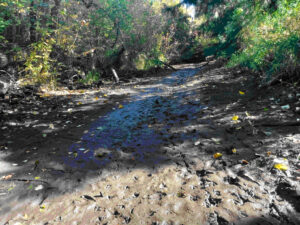
South Clover creek above Golden Given Rd E on the 21st of October. The muck and sediment here is over a foot deep and in many places two or more. A survey of traffic is needed to determine which storm drains need to be replaced first.
_____________________________________________________________________
To solve the problem of no flow of water in Clover Creek in summer, the restoration of local aquifers with rain water will be needed to restore a year-round flow. As the aquifer level increases, the groundwater surrounding the creek will raise creek level and also increase the health of the trees that shade the creek for salmon habitat.
Also in 2024, the County Council passed a Low Impact Development requirement for new commercial and home construction. It calls for containing rainwater on the building site. By using rain gardens, swales, holding ponds and injection wells the aquifers can be restored.
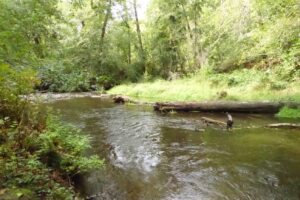
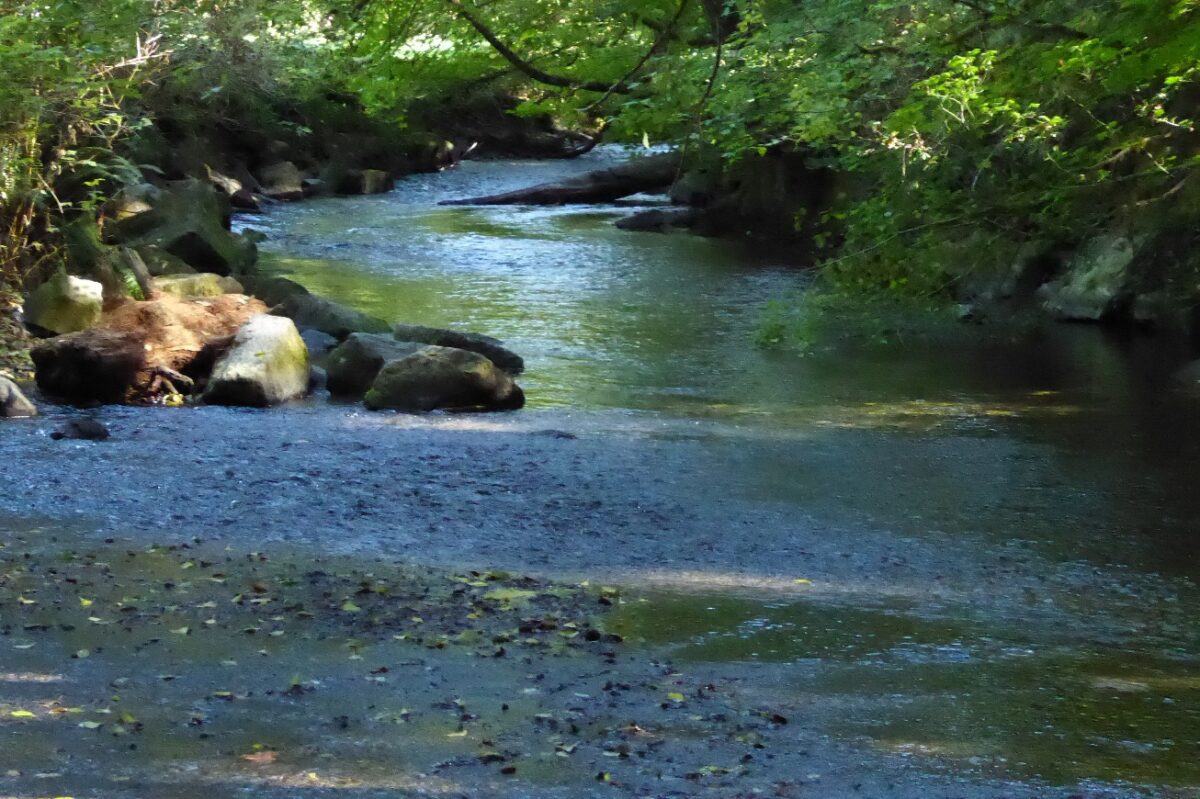
Photo of October flow in Chambers Creek Canyon near Bridgeport. Flow is from University Place and Tacoma which need to have their storm water drains prioritized for updating. Clover Creek runs dry here in summer when there is no flow out of Lake Steilacoom.
_____________________________________________________________________
To measure the effectiveness of restoring the aquifers, the Tacoma Pierce County Health Board was tasked to set up a long-term groundwater monitoring program to measure the effectiveness of restoring the aquifers.
The monitoring was intended to 1) monitor water levels and identify significant trends, 2) determine groundwater resource availability in relation to expected population growth, and 3) monitor water quality parameters and significant trends.
The Health Department issued the last of their reports in 2005 and in 2007 then the program ended. During this time water data was collected on 146 wells. The 2007 report concluded out of 48 wells tested in the Chambers-Clover Watershed, 20 showed indication of declining water levels. Such data will be invaluable to identify changes in groundwater. Trend data could inform decision makers on issues like when will drinking water diminish to the point that waste water will need to be cleaned and returned to the ground.
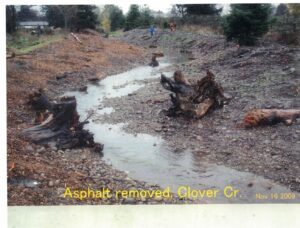
Asphalt removed from creek in 2009 to allow water to recharge aquifer near Parkland Prarie. Well data will provide data on how effective injection wells and the creek flow into the aquifer to raise the ground water and return year round flow into this intersection.
___________________________________________________________________________
The restoration of aquifers and the increase in ground water in Clover Creek has benefits beyond the restoration of aquifers and salmon habitat. The increase protects tree canopy which would die or catch fire over time if the summer droughts continue.
Summer droughts combined with heavy rains in the winter are forecast as the effects of Climate Change. Increase in temperatures can be offset by the carbon sequestering of forests. Trees also offset the carbon emissions that come from increased traffic with continued urban development in the county.
Global warming is going to provide both a benefit and a tragedy in the coming decades. If we want a sustainable water program, we can capture the flooding that is likely to occur in the winter and then use the water to increase the ground water during the summer droughts.
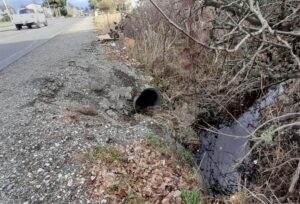
Where 112th street crosses North Fork of Clover creek drains like this one need filters to remove poison from car tires that flow into the stream after rainstorms. Some drains cost over $3.5 Million to replace.
_________________________________________________________________________
The capital funding for storm drains will come from grants by the Department of Ecology. Paying for their design and contracting will require an increase in storm water fees across the county. The fees have not been increased in the last 8 years.
We want the initial replacement of drains to be located on the busiest roads and arterials near Clover Creek. Unfortunately in the last 3 years only two of the “C Street” drains have been designed and put into the updated Surface Water Improvement Program for 2026-2031.
- Project # D235, North drain on C Street, will be completed in 2027 at a cost of $3.546 million.
- Project # D249, South drain on C Street, is planned for completion in 2029 at a cost of $2.179 million.
Al Schmauder, the Water Steward for the Chambers/ Clover Creek Watershed, brought these drains to the attention of the Surface Water staff prior to May 2021.
At the present rate, fixing the North drain will take about 6 years and the South drain will take about 8 years. The completion date is a problem because Chinook Salmon are spawning in Chambers Creek now.
If road runoff containing 6PPDQ is not filtered by storm drains in Clover Creek above Spanaway Loop Road, then the young salmon down stream could be harmed long before the county updates the first drain — eight years from now.
The budget provision in 2025 asks to have grants applied for in 2026 and 2027 while there is still grant money available from Ecology to pay for the capital costs.
The county budget process is often an adventure. This year there was a large deficit bt to cover. The fees charged by many government departments had not been raised for years. Surface water Management hadn’t received increase for 8 years. We were lucky to have our project inserted in the last days of the budget process.
Thanks to Robyn Danson, Bryan Yambe and Jani Hitchen who refined our proposal and inserted it into the process during one of the last budget hearings.