State Governors and Supreme Court Stand Up to Trump’s Bullying
by Kirk Kirkland
It has been a gruesome year for those who see Donald Trump’s first year in office clearly. It’s been a parade of nightmares—corruption on a scale undreamed of and the shocking capitulation by many leaders in business, law, media, and academia.
For those who have lost hope, take heart and review this list of the political and legal acts of rebellion against the Trump administration. A small group of state governors and court judges have turned the tide against the Trump administration. These are stories that don’t always make the front page of a newspaper or the nightly news. But taken together, these people have refused to surrender to this administration’s bullying. Notice that although his administration has been able to do extraordinary damage that will have generational effects, he has not successfully consolidated power, nor has he proposed reforms to rebuild what he has destroyed.
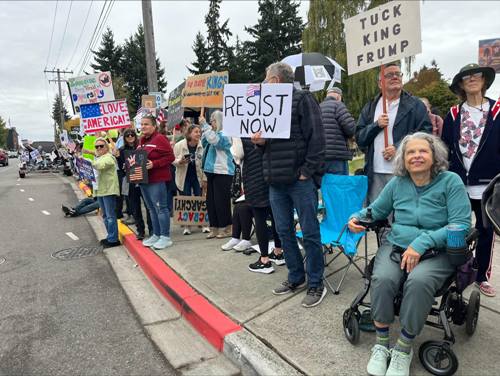
The best example of reaching a turning point was in June, when Trump’s military parade was a flop. That night, the focus of the newspapers and television news organizations was on the big-city streets full of people with the “No Kings” demonstration—the largest in our history.
In addition, his administration failed in its attempt to use the courts to conduct selective prosecutions of his foes. Judges have turned 17 lawsuits filed against his enemies into court stays. The best example is a New York grand jury’s refusal to indict Letitia James, New York’s Attorney General, whom the administration accused of mortgage fraud with no credible evidence.
Much of the credit for the reinvigoration of the resistance belongs to Trump himself. He’s still a dangerous president feeling increasingly cornered and aggrieved, as seen during the renaming of the Kennedy Center for the Performing Arts.
Note too, that after 11 months and so much destruction, the administration has not consolidated authoritarian control of this country. At the same time, governors are stepping forward and using the 10th Amendment to enforce the rule of law.
The U.S. Supreme Court ruled against him in December when he ordered the National Guard into Chicago. In an unsigned decision, the conservative judges found limits to executive powers regarding the National Guard in states. With this decision and governors working together to pass the “No Secret Police Act,” you can see Trump as a bully in retreat, making a fool of himself as was evident in his speech at the Kennedy Center.
Adversaries’ Effective Use of the Rule of Law
In this list of victories, you can see that the governors of the states are using their power to enforce the rule of law. From undercutting our leadership in medical research to using ICE to make war on our cities, his administration is finding that the people have found a way of pushing back. In legal cases, advocates have stopped Trump cold with the use of the court stay.
For our community of environmentalists and advocates, the winter of uncertainty is giving way to a spring of strategic resistance, shifting political power away from the Executive and Congress as state governments pass laws in defense.
Section 1: Automobile Tariffs and the Economic Cliff
The domestic automobile sector has experienced a massive shift in 2025 due to the implementation of aggressive trade tariffs. Beginning in April 2025, the administration imposed a 25 percent additional tariff on imported passenger vehicles and light trucks. This plan began to crumble when Canada’s Prime Minister announced that Canada would not comply with the tariffs.
Canada holds a critical piece of the puzzle. While the U.S. often handles final assembly and Mexico produces complex electronics, Canada is the primary source for high-strength steel frames and core chassis components. This cross-border flow allowed the federal tariff wall to crumble for manufacturers like Ford and GM who rely on this integrated North American system.
The stakes could not be higher. Car manufacturing, repair, sales, and parts together employ nearly 20 percent of the people in our economy. By late 2025, the average price of a new car crossed the $50,000 mark, leading the U.S. Court of International Trade to rule that these tariffs were an unlawful overreach. While this ruling is currently under a temporary court stay, it marks a major legal victory against trade overreach.
Section 2: The PFAS Cleanup and the Senate Revolt
Environmental safety at military installations became a top-tier political issue this winter. The Department of Defense attempted to delay the cleanup of “forever chemicals” (PFAS) at nearly 140 military bases, pushing cleanup completion dates back as late as 2032.
The polarization of the Senate ended when independent-minded Republicans joined Democrats to keep poison out of our streams. With a bipartisan vote, they restored $200 million specifically for PFAS remediation. In Pierce County, the towns of DuPont and Lakewood are dependent on these funds for the continued cleanup from a spill at McChord Air Base several decades ago. This victory ensures that military families will not be abandoned.
Section 3: State Sovereignty and the West Coast Alliance
When the federal government began dismantling health safeguards, the West Coast states did not wait for permission. Governors Gavin Newsom of California, Tina Kotek of Oregon, and Bob Ferguson of Washington formed the West Coast Health Alliance. They have since been joined by over a dozen other governors from both parties, including Republican Governor Phil Scott of Vermont, to protect healthcare standards and insurance access for their people.
This is the 10th Amendment in action. These governors are proving that the Constitution reserves power to the states to protect the health and safety of their citizens.
Section 4: The No Secret Police Act
The movement for identifiable policing is sweeping the nation. In Minnesota, Governor Tim Walz and his police leadership took a strong position against the federal handling of immigrant apprehensions. Walz famously stated: “If federal agents use unlawful force in this city, our officers will intervene.”
In Illinois, Governor J.B. Pritzker issued a dynamite response to threats of federal troop deployment. According to the New York Times and official press transcripts, Pritzker told the White House: “I will not call the President asking him to send troops to Chicago… we do not want or need military occupation in our city.” He warned federal officials: “We are watching, and we are taking names… you can delay justice for a time, but history shows you cannot prevent it from finding you eventually.”
In Washington, Governor Bob Ferguson has been equally vocal. According to an August 2025 press briefing at the State Capitol, Ferguson stated:
“Washington State will not be bullied or intimidated by threats and legally baseless accusations… we are not going to have local law enforcement assisting masked agents jumping out of unmarked cars and pulling people off the streets.”
The “No Secret Police Act” is now moving through the Washington State Legislature for the 2026 session. It is being championed by local Tacoma leader, Senator Yasmin Trudeau, alongside Representative My-Linh Thai. This act requires all officers to show their faces and badges and allows masked officers to be sued personally for at least $10,000. Similar bills are currently being drafted or moving through legislatures in Illinois, New York, and Massachusetts, creating a unified legal firewall across the country.
Section 5: Leadership for the Midterms
Our movement has clear, vocal leadership. From Governor Newsom’s “firewall” in California to Governor Pritzker’s legal challenges in Illinois, the pushback is coordinated. We see it in the work of Congressman Jamie Raskin and Senator Mark Kelly (the former astronaut who has challenged the administration on its military overreach and illegal orders).
The November 2025 election of new governors, like Abigail Spanberger in Virginia—who won by a decisive 15-point margin—shows that the political landscape is tilting toward the Democrats taking back the government in the 2026 midterm elections. The “Blue Wall” of governors is no longer just a defensive line; it is an active force for the rule of law.
Section 6: NOAA and the Legal Firewall
The National Oceanic and Atmospheric Administration faced a threat this year when the administration moved to privatize weather data. This led to the loss of critical weather balloon data. However, the strategy of the court stay has become a national bulwark.
The Sierra Club and its legal partners successfully secured court stays to block illegal attempts to sell off public lands and open 1.5 million acres of the Arctic National Wildlife Refuge to drilling. Judges are ruling that the administration cannot ignore the law to favor corporate polluters.
Conclusion: The Shield and the Map
We are learning that a court stay is not just a delay; it is a victory of facts over ideology. Whether it is the clean water in the streams of Lakewood or the No Secret Police bill in the state legislature in Olympia, the wall of reality is holding.
We no longer look to the White House with fear; we look with hope to the statehouse, the courthouse, and the rule of law.