
Environmental justice and Tiny Home Village
When the first yellow sign with public notice went up in the forested area surrounding Audubon Springs, the neighbors had no way of knowing that their appeal of the Tiny home Village with some 280 homes would cost over $100,000. Unfortunately this was only a down payment on a hearing that continued for two weeks costing an initial estimate of $5,000 a day.
One day after the local county Land Use Advisory Board voted to deny the project, the county planning staff made a Determination Of Non-significance which decided that all of the environmental impacts could be mitigated by a traffic study and making a few adjustments to wetland buffers.
This meant that the neighbors now had to pay a $4,000 appeal fee to the force the county to make an environmental review that should have been obvious. Any other development that would have been an automatic environmental review if it proposed putting over 300 people in a Rural Resource Zone or called for the removal of more than 670 trees of a protected species of Oregon White Oaks.
Do people care about this issue? On the first day of public hearing 104 people attended the hearing in person and another 80 people attended by zoom. And many more cared enough to donate to Spanaway Concerned citizens to pay off their April attorney’s bill of $45,000.
Unfortunately this hearing is only the first of several coming court appeals that will determine if an Environmental Impact Statement (EIS ) is required for a project that will put over tiny houses and recreational vehicles in a dedicated wildlife corridor.
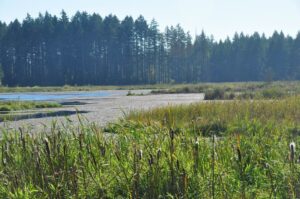
The Pierce County Village forest plan, proposed cutting down 670 pristine, old growth forest, and legacy trees, including Oregon White Oak — a listed species. The over 88 acres contains Category I wetland system that supplies a large percentage of water to Spanaway Lake and the rapidly diminishing Chambers/Clover Creek Watershed.
In 2000 the state highway department proposed building a four-lane freeway through a place called Audubon Springs, one of several Class I wetlands. The Environmental Impact Statement was challenged by the Center for Biological Diversity. The court found that the road would disturb the forest habitat of a Western Gray Squirrel.
Now the Western Gray Squirrel is back in the headlights of builders as this project doesn’t just reduce the squirrel’s habitat, it destroys it. The squirrel’s return appearance in the discussion comes with an elevated status after the state Department of Fish and Wildlife did an assessment and declared the WG Squirrel as “endangered.”
To protect this area, the county planning department designated these 80 acres as a Rural Reserve zone. The state Fish and Wildlife Department designated it as a Priority Wildlife Corridor to protect the endangered species and Oregon White Oaks. Then the Pierce County Council designated these 80 acres as one of seven Biodiversity Areas in the county.
The April 2024, letter from WDFW said:, “This development proposal will further encroach upon and will reduce the existing (WGS) primary habitat.” One of only three habitat sites remaining in Washington State.
So, why this site? The Pierce County Council did request a list of alternative sites to meet this criteria. The proposed sites had to be owned by Pierce County, situated near public transportation and within the unincorporated growth area. The Spanaway Marsh parcels were neither owned by Pierce County, nor near public transportation.
In Pierce County there are three alternative sites of 40 acres or larger that are available to build a Tiny Home Village inside a city or in the county’s Urban Growth Area. Most sites have access to grocery stores and other basic services. When this project is reviewed with an Environmental Impact Statement, the state law requires that an alternate site needs to be included if the initial proposal can not mitigate damages to the wetlands, trees or endangered species.
Any one of these alternatives would be better than banishing the homeless to a swampy area on the borders of Spanaway Marsh.
Called the “Good Neighbor Village”, the proposal is more than a Tiny Home Village. It is more like a travel trailer park for “park-model-style recreational vehicles, micro sleeping units, with a central bath & communal kitchens, and community support buildings which includes a dog park, civic building and 285 parking spaces,” all within the confines of an 30 acre area that is both ecologically and hydrologically sensitive.
While acknowledging the pressing need for a dedicated community to address the needs of our chronically homeless in Pierce County, the project is situated upon the wetland delta of a watercourse flowing into Spanaway Lake. This location is susceptible to periodic groundwater flooding. But most important the area is isolated from supportive services.
Members of the Spanaway Concerned Citizens wholeheartedly endorse the pressing need to establish a novel approach to address the needs of the chronically homeless here in Pierce County. However, it is imperative to consider the consequences of housing vulnerable individuals within a delicate ecosystem, according to speakers from Spanaway Concerned Citizens said at the hearing.
“As stewards of both human welfare and environmental preservation, the county must prioritize the, safety, and long-term stability of our chronically homeless population. This location presents substantial risks that need not be overlooked.”
Not many groups faced with such a bold challenge to their peace and quiet are able to raise this kind of funding. Very few would be able to raise money for future appeals. But the people in Spanaway and Parkland are undaunted in their support.
With the decision expected in the last week of May, it is crucial to underscore that their journey through the court system is far from complete.
Generous donations are the lifeblood of the Spanaway Concerned Citizens mission. As of the last week in May they have been able to pay most of their April bill of $45,000 which leaves a remaining balance of $12,000 to pay for the previous hearing.
Your support is both essential and valued. As mentioned earlier this is just one of the essential stops before a Pierce County Court and the state Court of Appeals. There is justice to be found in these upper level courts, but their legal journey is going to need your financial support.
Please take a moment to bring environmental justice to the neighbors of this rural zone and also to protect the wildlife corridor that surrounds Audubon Springs which is important for endangered wildlife to survive..
100% of your donation is for legal Fees
Send your contribution to:
Spanaway Concerned Citizens at
P.O. Box 562
Spanaway, Washington, 98387
Please make checks to Spanaway Concerned Citizens.
Online donation:
Large Industrial Geoduck farm opposed in Burley Lagoon
The long awaited appeal of the Industrial Geoduck farm in Burley Lagoon ended on May 29. Taylor Shellfish Company proposed a 28 acres aquaculture project — the largest in Pierce County. .
Taylor Shellfish faces an uphill battle for the county’s Conditional Use Permit that has been challenged by Friends of Burley Lagoon and a coalition of environmental groups in Pierce County. In 2019 a Federal court decision called for revocation of 900 geoduck aquaculture permits in the state. It also required that all new permits issued by the Army Corps o f Engineers or by Department of Ecology include a Cumulative Impact Analysis.
After revoking the geoduck permits in Puget Sound and Hood Canal, the Army Corps’ then resumed handing out over 600 permits without providing the required environmental review and analysis.
The Army Corps initially produced a Nationwide Permit 48 with their permits. This NWP-48 permit created an exception to allow aquaculture companies to grade, plant and harvest on the shoreline in a way that destroyed the benthic community, disturbed endangered birds and forage fish habitat and harmed Chinook Salmon, an endangered species in Burley Lagoon and South Puget Sound.
The NWP-48 permit was revoked in October 2023, leaving Taylor shellfish and other permit holders without an exception that allowed them to pollute the waters of the state under the Federal Clean Water Act.
Friends of Burley Lagoon and two other groups worked together and challenged the state priority given to aquaculture by the Army Corps, State Ecology Department and several county planning departments when handing out permits. The “priority for aquaculture” allowed shellfish companies to not meet the requirements of the state’s Shoreline Management Act. The Burley Lagoon appeal of Pierce County’s Conditional Use Permit was one of the first opportunities to ask for enforcement of the Federal Court Decision that called for Cumulative Impact Analysis for all new permits since 2019.
The Center for Food Safety and The Coalition To Protect Puget Sound Habitat played a key role in obtaining the federal decision. And since then they have only been able to file appeals on only a few of the over 600 permits approved by the Army Corps. Each appeal of 10 permits takes time to get on the Federal Court roster and to present their case.
Opponents of the spread of Industrial Aquaculture hope that this Burley Lagoon hearing might just be the tipping point when the tide is turned against the Ecology Department, and county planning departments and have them recognize the damage done to the beaches and shoreline by planting and harvesting activities.
During the Pierce County hearings the biggest impact that witnesses discussed was the loss of recreation and the disturbance by harvesting in the middle of the night. The harvesters use lights and make noise that disturbs many residents their sleep in the middle of the night. These operations have turned the lagoon, a state Shoreline of Significance, into an industrial zone.
Already the Department of Natural Resources is surveying the loss of eelgrass state wide and is planning a restoration program. And a recent state Court Of Appeals decision has made it possible to challenge the previous “preference for aquaculture” that gave Industrial aquaculture to damage shoreline habitats for Pacific Salmon, forage fish and the eelgrass that is necessary for their survival.
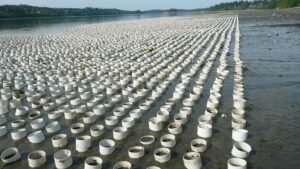
The state “Preference for Aquaculture” allowed permit holders to avoid mitigation that is required by the Shoreline Management Act. It allowed degradation of beaches when the geoduck industry put 450 plastic pipes per acre in the beach,
Three members of the Environmental Coalition of Pierce County joined with 12 other witnesses from the Friends of Burley Lagoon when the public hearing began on May 21.This same team from the Environmental Coalition joined 40 other people earlier this year when they asked the Gig Harbor Land Use Advisory Board to Deny the permit.
The Gig Harbor Land Use Advisory Board voted to deny the permit.
Unfortunately, this May 2024 hearing is only the beginning of a three step process of appeals to appear before the state Court of Appeals with a request for Pierce County to abide by the 2019 Seattle Federal Court Decision that required a Cumulative Impact Analysis for all new permits.
At the Burley Lagoon hearing last week the county appeal centered on asking the Hearing Examiner to require the county planning staff to abide by the Federal Court ruling and perform a Cumulative Impact Analysis of South Puget Sound and determine if a 28+ acre geoduck farm would have a “significant” impact on South Puget Sound.
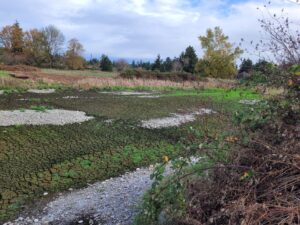
Recently passed amendments to review water systems in the county have made it possible to re-think how the county can change the crisis of expanded growth and increase problems with drought, flooding, and water shortages into proposals that could turn these problems into opportunities to recharge aquifers, increase ground water and get creeks flowing while at the same time increasing water supply for some of the county’s water providers.
_____________________________________________________________________
County Council’s Comp Plan amendments address Climate Change issues
Pierce County public works is in a unique position to respond to the crisis of global warming caused by flooding, forest fires, droughts. New Amendments to the County Comp Plan make it possible to decide to capture the annual increased rainfall of 15 inches in winter and use the water to restore the county’s aquifers, to raise ground water to restore creek flow, and reduce forest fires along creek corridors.
This spring four environmental organizations worked together to respond to the County’s Environmental Impact Analysis that examined how the county Public Works and Planning departments would respond to a substantial increase in population. Our combined letter encouraging Alternative 3 options also suggests a more sustainable response to global warming possible by storing flood water in the county’s aquifers.
Based on our combined letter and other responses of people who attended Planning Commission Hearings, the Pierce County Council members proposed 20 amendments to the County’s Comprehensive Plan that laid the necessary foundation of how we can create a more sustainable county infrastructure to support the coming of the next 100,000 people.
At an in-person hearing before the Pierce County Council meetings in May there was no consensus on how to respond to the future. A large group of people opposed the removal of the Bonus Density in the rural areas of the county.
This Bonus Density allowed people to double the number of houses that could be built in rural zones of the county. Such an increase in density would require Public Works to build more roads, extend sewer lines into remote areas, and cause rural school districts to build more high schools to serve the new arrivals. Such expansion beyond city’s and county’s urban growth boundaries would require county wide increase in property taxes as the taxing ability of rural areas can not pay for the extension of these public services.
This is why one of the county council amendments called for stopping the expansion of Canyon Road. Instead it appropriated the funding to fixing the bridge over the Puyallup River which would improve traffic flow across the entire county. Expanding the Canyon Road, however, would expand housing into the Rural Separators near Puyallup that would need expanded sewers, schools, and fire service.
This amendment also preserved critical farmland to provide local food for growing demand by not paving over Puyallup Valley farmland with Canyon Road. In addition stopping the bonus density was essential to comply with the State Transportation goal to reduce Vehicle Miles Traveled (VMT) in the next decade.
Reducing VMT is an essential goal to curb carbon emissions and reduce long commutes to work from rural areas. With Climate Change affecting other parts of the country with hurricanes, tornadoes, flooding, heat waves and storms, our county has a unique opportunity to anticipate problems with flooding and forest fires and consider solutions to these problems.
We face a grim future of increased rainfall causing flooding in the winter and increased drought in the summer. Such a drought will lead to increased forest fires and smoky skies.
The amendments passed by the county council is the road map to change the chaos into opportunity. The amendment to review of the county’s water systems is the policy change to look at innovative ways to insure water supply for increased housing while at the same time capturing the flood water to use to raise the water level in our creeks in late summer. Increased ground water will prevent forest fires if creeks near forests dry out in late summer.
Another trade off is for the county to restore storm drains with filters on 112th street and other arterials. The flood water of Clover Creek then can be injected into the Spanaway and Parkland aquifers. To filter 9 drains would cost $9 million over a period of years, but this change would avoid damage caused by flood waters that do downstream damage to Pacific Avenue and Spanaway loop Road.
Recharging of the aquifer in Parkland was done in the past when Clover Creek passed through rural areas. Will this increase taxes to fix storm drains?
Tax payers are already paying a surface water fee which could be used in the UGA instead of in other rural parts of the county.
In addition the aquifers under Parkland and Spanaway could be filled with the increase in sewer demand. A scalping plant could remove treat the local sewage and use it to restore the aquifer. Why send the sewer water to be purified at a Chambers Bay facility then released into Puget Sound, when it could be reused in Spanaway keeping the water company in business to meet the increased housing demand.
Can we afford such a sewer plan? Yes, the buyer of each new house already pays for a portion of the capital cost to expand the existing sewer system. Instead the current funds collected in Spanaway and Frederickson expansion could build a plant in Spanaway. In a word,the increase in housing pays for the cost of growth.
The county doesn’t have to experiment when adapting this innovation. It has already been done in Lacey and on the Orting Plateau where plants are re-injecting their treated sewage into the aquifer.
Stopping forest fires in rural and urban areas of the county can also be paid for by expanding existing programs by the county’s Department of Emergency Services. The program to remove combustible materials in the forests can be paid for by thinning the forests, which reduces the problem with canopy fires.
sale of timber from thinning the forests can be used for paying for removal of materials. Thinning is needed for healthy forests, as two percent of the trees can be removed each year without changing the integrity of the forest.
Along the Texas and Louisiana Gulf Coast the warming of the Gulf is causing destructive storms and tornadoes that destroy towns and flood rivers. Their government funds are totally dedicated to rebuilding infrastructure and rebuilding towns. Sea level rise on the Atlantic Coast from increase in Gulf Stream temperatures is requiring rebuilding of sewers systems on higher ground at great expense.
Here in the Northwest, we have the leadership that is willing to look into the chaos coming in our future then act now to re-appropriate the taxes collected in existing programs. We can change flooding issues into increased water supply and drought issues into a method of increasing water in our creeks, and we can change fire damage to our forests into a program that creates healthy forests that will continue to provide carbon sequestering that reduces the carbon emission of our transportation systems.
We can reduce the threat of climate change by creating more sustainable public works programs. It is essential to do this while we have an adequate tax base, before all of it is used for emergency services and the disaster relief caused by flooding, drought and forest fires. It is within our grasp.
[= end